
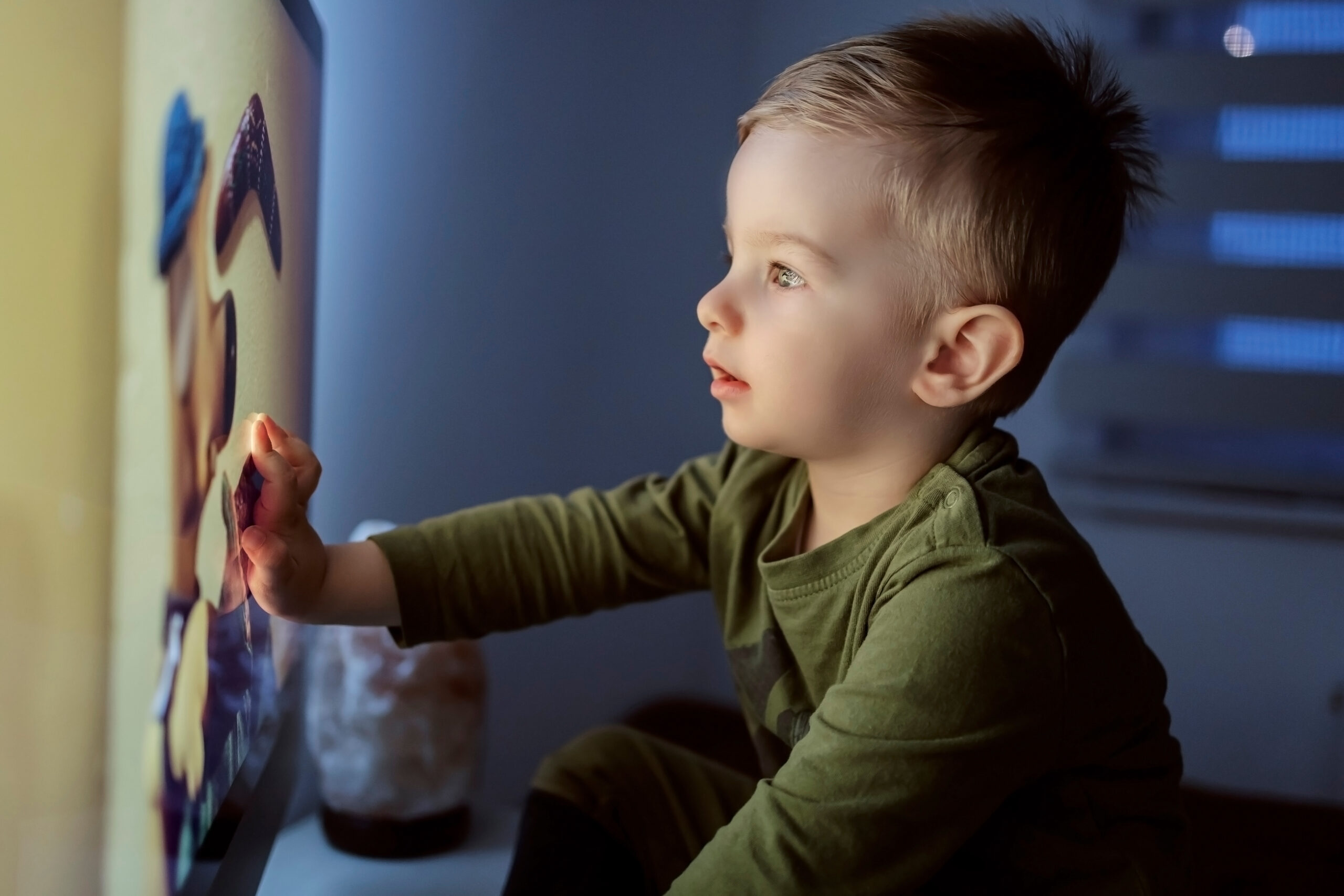
Screens are part of everyday family life. For autistic children, a tablet, television, phone, or computer may provide entertainment, comfort, learning, communication, connection, or help during difficult transitions.
Screen time is not automatically “good” or “bad.” What matters most is how your child uses the screen, when they use it, and what the screen may be replacing.
A helpful question is:
Is this screen helping my child communicate, connect, learn, relax, or participate—or is it regularly replacing sleep, play, movement, and interaction?
The goal is not to eliminate every screen or make parents feel guilty. It is to use screens thoughtfully while protecting the everyday experiences that help children grow.
How Does Screen Time Affect Autistic Children?
Screen use does not affect every child in the same way. Its impact may depend on:
- Your child’s age and individual needs
- The type and pace of the content
- Whether your child uses the screen alone or with someone else
- The time of day
- How easily your child can stop
- What your child would otherwise be doing
Screens may be especially appealing to autistic children because they are predictable, visual, repeatable, and easier to control than many everyday interactions.
Digital tools can also be genuinely helpful. They may support communication, organization, learning, social connection, and access to favorite interests. However, screen use may become a concern if it repeatedly interferes with sleep, movement, shared play, family interaction, or participation in daily routines.
The American Academy of Pediatrics encourages families of autistic children to consider the quality and purpose of media use—not simply the number of minutes spent on a device.
Not All Screen Time Is the Same
Different types of screen use provide very different experiences.
For example:
- Using an AAC device to communicate is different from watching entertainment videos.
- Video-calling a grandparent is different from watching videos alone.
- Watching a short show with a parent is different from hours of autoplay content.
- Using a visual schedule is different from playing a fast-paced game before bed.
- Using a favorite video to inspire pretend play is different from allowing the video to replace play.
Instead of asking only, “How much screen time does my child get?” consider asking:
- What is my child watching or doing?
- Is my child using the screen alone or with someone?
- What need is the screen meeting?
- What activity is the screen replacing?
- How does my child seem during and after screen use?
- Is stopping especially difficult?
- Is the screen being used close to bedtime?
- Can we bring this interest into an off-screen activity?
These questions can help you make useful changes without treating all screen use as a problem.
Screen Time and Sleep
Evening screen use deserves special attention, especially if your child has difficulty falling asleep, staying asleep, waking in the morning, or managing emotions during the day.
A 2023 study involving preschool-age autistic children found a connection between screen use before bed, sleep habits, and behavior. The study did not prove that screens directly caused the concerns, but it supports taking a closer look at evening routines when sleep is difficult. Read the study in BMC Psychiatry.
Try reducing entertainment screens during the last 30 to 60 minutes before bedtime when possible. If your child depends on a familiar screen routine, make changes gradually.
A predictable bedtime sequence might look like this:
Dinner → one show → tablet charges in the kitchen → bath → pajamas → book → bed
You can also use:
- A visual bedtime schedule
- A visual timer
- First/then language
- Transition reminders
- The same stopping phrase each evening
- A designated place where devices charge overnight
For example:
- “First one episode, then bath.”
- “The timer is finished. The tablet charges now.”
- “Video is all done. Next is pajamas.”
A calm, consistent transition is often easier than suddenly taking the device away.
Can Electronic Toys Affect Language Development?
Many electronic toys are advertised as educational because they sing, flash, name letters, or play recorded phrases. However, a toy that does most of the talking may leave fewer reasons for a child or caregiver to communicate.
A 2022 study found that autistic children and children developing typically used fewer spoken messages and fewer different words while playing with electronic toys than while playing with traditional toys. This does not mean every noisy toy is harmful. It suggests that simpler toys may create more opportunities for interaction. Read the study in Frontiers in Psychology.
Electronic toys can sometimes take over the play. When a toy continuously talks, flashes, or directs the activity, a child may have fewer natural opportunities to:
- Ask for help
- Request another turn
- Comment
- Copy an action or sound
- Make a choice
- Protest
- Take turns
- Pretend
- Get another person’s attention
A useful guideline is:
Choose toys that invite interaction instead of toys that perform the entire interaction.
Language-friendly choices may include:
- Blocks
- Cars and ramps
- Toy animals
- Dolls and figures
- Pretend food
- Bubbles
- Balls
- Puppets
- Books
- Art supplies
- Sensory bins
- Simple cause-and-effect toys
You do not need expensive or specialized toys. Everyday objects and familiar activities often provide wonderful reasons to communicate.
How to Encourage Communication During Play
You do not need to quiz your child or turn playtime into a therapy session. Try using short, playful words and then pause.
For example:
- “Cow! Moo!”
- “Ready, set…” and wait for your child to communicate “go.”
- “My turn. Your turn.”
- “Help?”
- “Again?”
- “More?”
- “All done?”
Your child may respond by speaking, making a sound, looking, reaching, pointing, signing, handing you something, or selecting a message on an AAC device.
All of these can be meaningful forms of communication.
How to Make Screen Time More Helpful
Reducing screen time is not the only option. You can also add interaction, play, movement, communication, and predictable routines to the screen time your family already uses.
Add connection
Sit with your child for a few minutes during a favorite show or game. You might copy an action, laugh together, name an emotion, or make a short comment.
For example:
“He’s jumping! Jump, jump. Can you jump?”
You do not need to talk through the entire program. A few genuine moments of shared enjoyment can be valuable.
Add real-world play
Use your child’s favorite screen interests as a bridge to play.
If your child enjoys train videos, you might:
- Build a track
- Count toy trains
- Sort trains by color
- Practice “go,” “stop,” “fast,” and “again”
If your child loves animal videos, you might:
- Play with animal figures
- Copy animal sounds
- Match animals
- Take turns choosing animals
- Pretend to feed or care for them
If your child loves a particular character, you might:
- Draw the character
- Dress up like the character
- Act out a familiar scene
- Build the character’s home
- Talk about how the character feels
Favorite interests can be powerful tools for learning, connection, and communication.
Add movement
Screen activities usually involve sitting, so build in brief movement breaks.
Try:
- “After one video, we jump 10 times.”
- “First the game, then animal walks.”
- “Let’s have a dance break between episodes.”
- “Race to the kitchen when the timer rings.”
Movement may help some children feel more organized, alert, and ready to transition.
Add communication
Use motivating screen activities to model useful messages through speech, gestures, signs, pictures, or AAC.
Helpful words and phrases may include:
- Go
- Stop
- Help
- Again
- More
- All done
- My turn
- Your turn
- I like it
- I don’t like it
Focus on your child communicating the message—not on saying the word perfectly.
Add a predictable ending
Ending screen time can be hard, especially for children who rely on predictability or find transitions stressful.
You can make the ending clearer by:
- Turning off autoplay
- Using a visual timer
- Choosing a natural stopping point
- Giving a reminder before the activity ends
- Showing your child what comes next
- Using the same ending phrase each time
For example:
- “One episode, then snack.”
- “When the timer ends, the tablet charges.”
- “Video is finished. Now we play with blocks.”
Predictability does not guarantee that your child will be happy about stopping, but it can make the transition easier to understand.
Protect AAC and Other Communication Tools
An AAC device is your child’s voice. It should not be treated the same way as an entertainment device.
A family may decide to limit videos or games without restricting access to:
- AAC
- Visual schedules
- Social stories
- Communication apps
- Therapy activities
- Helpful regulation tools
It may help to divide technology into three categories:
- Communication tools: Available whenever your child needs to communicate.
- Learning or therapy tools: Used with a clear purpose and, when appropriate, adult support.
- Entertainment media: Managed according to your family’s routines, content choices, timing, and transition plan.
If your child’s AAC system is on the same tablet used for entertainment, work with your child’s speech therapist to create boundaries that protect communication access.
Start With One Small Change
You do not need to change your family’s entire routine at once. Begin by noticing when and why your child uses screens.
Ask yourself:
- When does my child use screens most often?
- Which shows, games, or apps are most common?
- Are screens used during meals, outings, transitions, or bedtime?
- Is my child usually alone or with someone?
- What happens when screen time ends?
- Is the screen helping with communication, learning, calming, waiting, or avoiding a difficult activity?
- What realistic alternatives could meet the same need?
Then choose one manageable step.
For example:
- If sleep is difficult: Begin moving entertainment screens away from bedtime.
- If communication is a concern: Join your child for five minutes of a favorite activity and model a few useful words.
- If transitions are difficult: Use a visual timer and the same ending routine each day.
- If your child depends on a screen to calm down: Slowly build a small menu of additional calming choices.
- If electronic toys dominate play: Replace one noisy toy activity with blocks, animals, pretend food, or another simple toy.
- If your child has a strong favorite interest: Use it to inspire drawing, movement, pretend play, or conversation.
Small changes are more likely to become lasting routines.
Finding a Healthy Balance for Your Family
Most parents use screens because they meet a real need. A screen may help a child wait at an appointment, settle after a demanding day, enjoy a special interest, communicate, or give an exhausted parent time to prepare dinner.
There is no value in making families feel ashamed about that.
The goal is to make screen use more purposeful while protecting the experiences children also need: sleep, movement, play, communication, connection, and participation in family life.
Turning off autoplay, moving devices away from bedtime, joining your child during a favorite video, or replacing one electronic toy with shared play may seem like small steps. But small, consistent changes can create more opportunities for your child to connect and communicate.
If you are unsure how screen use may be affecting your child’s communication, sleep, or daily routines, talk with your child’s speech therapist or pediatrician. Together, you can develop a plan that fits your child and your family.
Sources
American Academy of Pediatrics / HealthyChildren.org. “How should I handle my child’s media use if they have autism spectrum disorder?” This source supports recommendations related to shared media use, unplugged spaces, visual timers, using preferred media interests as learning bridges, and safety considerations for online gaming.
https://www.healthychildren.org/English/tips-tools/ask-the-pediatrician/Pages/How-should-I-handle-my-child%E2%80%99s-media-use-autism-spectrum-disorder.aspx
Dong et al., BMC Psychiatry / Springer Nature, 2023. “The relationship between screen time before bedtime and behaviors of preschoolers with autism spectrum disorder and the mediating effects of sleep.” This source supports the discussion of bedtime screen use, sleep habits, and behavior concerns in preschool children with autism.
https://bmcpsychiatry.biomedcentral.com/articles/10.1186/s12888-023-05128-6
Venker & Johnson, Frontiers in Psychology, 2022. “Electronic Toys Decrease the Quantity and Lexical Diversity of Spoken Language Produced by Children With Autism Spectrum Disorder and Age-Matched Children With Typical Development.” This source supports the discussion of electronic toys, spoken utterances, lexical diversity, and caregiver-child language opportunities.
https://www.frontiersin.org/journals/psychology/articles/10.3389/fpsyg.2022.929589/full
American Academy of Pediatrics, 2026. “Digital Ecosystems: Children and Adolescents.” This broader AAP policy statement supports the recommendation to consider the quality, context, timing, and function of media use rather than relying only on total screen-time minutes.
https://publications.aap.org/pediatrics/article/157/2/e2025075320/206129/Digital-Ecosystems-Children-and-Adolescents-Policy