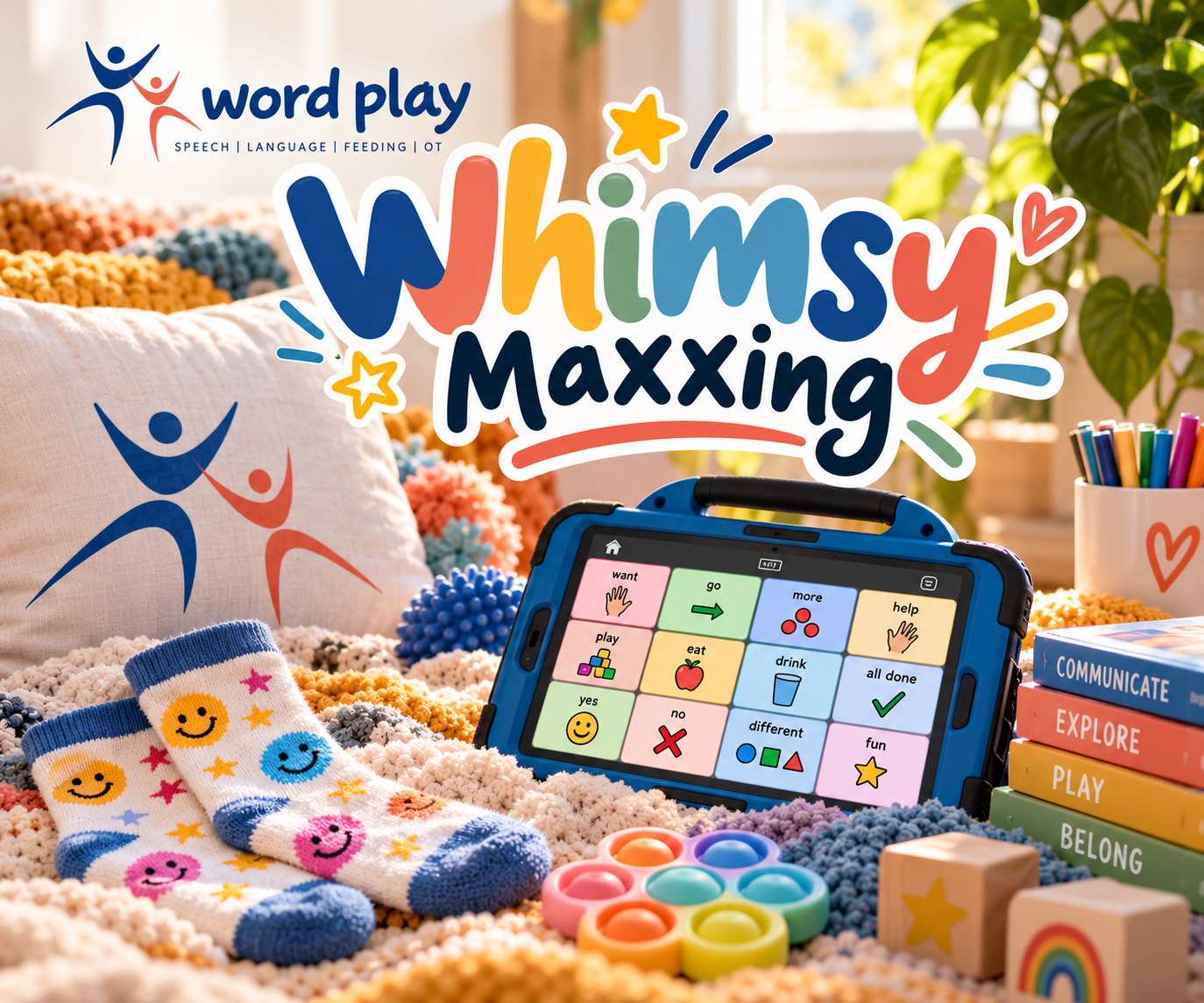
A little shared silliness can make room for a lot of communication
The internet has given everyday silliness a very ambitious name: whimsymaxxing. At Word Play, we are happy to welcome any trend that lets a sock become a microphone. No craft-store expedition required.
Whimsymaxxing means adding playful surprises to ordinary life. For families and support partners, those moments can create reasons to notice, choose, comment, protest and share an idea. The important ingredient is another person who responds. A perfectly arranged activity can wait; the sock has breaking news.
Let the fun carry the conversation
Try a household news report. Hold a pretend microphone and announce, “Breaking news: one shoe has disappeared.” Invite a partner to contribute a sound, gesture, augmentative and alternative communication (AAC) message or sentence. Respond to the meaning: “You think it is under the chair!” This opens space for commenting and describing without turning the game into a test.
Or visit your very own living-room museum. Each person chooses an ordinary object and gives it an extraordinary title. A spoon becomes “The Royal Soup Shovel.” Describe its size, use or texture. A person using one word might say “big”; you can add, “Big spoon.” A more experienced storyteller might explain how it came to belong to a dragon.
For a calmer moment, look through a window together. Notice something moving, make up a title for the view, or choose what to watch next. Shared attention can be toward the same event; eye contact is not a requirement.
Make it an invitation
Follow the person’s interests, model a short message, then pause long enough for their response. Try a comment before another question. If they say “car,” you might say “Fast car!” If they select “stop,” stop. Keep their usual communication system available, including words for refusing, asking for help and changing the activity. Participation should never depend on copying a word correctly.
Adapt for children and adults with substantial support needs
Support needs tell us more than labels such as “low functioning.” Someone may need considerable help with movement or speech and still have strong preferences, humor and understanding. Start with what that individual enjoys and how they already communicate.
Make the activity concrete. Show two real objects, demonstrate one action, and offer a short turn. If two choices are overwhelming, present one at a time with an option to decline. Use the person’s established eye-gaze, switch, gesture or yes/no response. Do not assume that looking at an object always means choosing it; confirm their meaning.
Model on AAC while you speak when that is part of the person’s communication plan. You can point to “again” during a favorite routine without requiring imitation. AAC includes many forms of communication and has no prerequisite test of readiness. An SLP can help identify an accessible system and partner strategies. [1]
Offer a quiet version, a shorter turn, a seated position or simply watching together. Ask before helping someone move or touching their materials. If they turn away, become uncomfortable or signal “finished,” acknowledge it and offer a break. Their choice to stop is successful communication. [2]
For adults, use adult interests: favorite music, sports commentary, travel postcards, decorating or a mock radio show. Keep your natural adult voice. Replace a toy-animal story with a familiar hobby if that is what the person prefers. Simple language does not require childish content.
Try one shared moment
Our Shared Whimsy Communication Deck offers 24 activities, each with a communication opportunity, an example message, a higher-support option and an adult adaptation. Choose one. Repeat a favorite. A minute of mutual enjoyment can be the whole activity.
These activities offer everyday communication opportunities and do not replace an individualized speech-language therapy plan. The deck itself has not been evaluated as a treatment.
[1] ASHA, Augmentative and Alternative Communication: https://www.asha.org/Practice-Portal/Professional-Issues/Augmentative-and-Alternative-Communication/
[2] National Joint Committee, Communication Bill of Rights: https://www.asha.org/NJC/Communication-Bill-of-Rights/